Events & celebrations
Panamanian Folklore and Traditional Music: Rhythms, the Pollera and Festivals
A guide to Panamanian folklore: tamborito, cumbia, mejorana, punto, congo and música típica, what the pollera means, and the festivals where you can see them.
Published on May 6, 2026 · 5 min read
Some countries are best known through their museums; others are best understood dancing. Panama belongs to the second group: Panamanian folklore is the most direct way to touch the soul of the isthmus. This guide explains its main rhythms and dances, what the pollera means, which festivals celebrate all of this most vividly, and how to recognize each tradition when you see it.
A Folklore with Three Roots
Panama's traditional music was born where Indigenous, Spanish, and African heritage met. Spain brought the guitar, the décima, and much of the traditional dress; Africa brought the drum, the call-and-response chorus answering a lead voice, and a communal way of dancing. Over the centuries, those roots blended into something entirely Panamanian.
Geographically, the folklore has two great centers. The Azuero Peninsula — above all the provinces of Herrera and Los Santos — is considered the cradle of much of the rural tradition: the pollera, the mejorana, accordion music. The Caribbean coast, especially the province of Colón, keeps the oldest Afro-Panamanian expressions, such as Congo culture.
The Rhythms and Dances Worth Knowing
The Tamborito, the National Dance
If one rhythm sums up Panama, it is the tamborito. It is danced in a circle: a female lead singer (the cantalante) guides the voices, a chorus answers with clapping, and the drums set the pulse while one couple after another steps into the center of the ring to court each other. It is traditionally carried by three drums — the repicador, the pujador, and the caja — and has been passed down through oral tradition for generations.
How to recognize it: a circle of people clapping, a woman's voice calling out the verse and a chorus answering back, and drums at the front of the sound.
Panamanian Cumbia
Panamanian cumbia is also danced in a ring, with couples moving around the circle. It is not the same cumbia you hear elsewhere in the region: it has its own steps, regional variants, and a more rural feel.
How to recognize it: couples circling the ring in a steady, rhythmic flow instead of staying in one spot.
The Mejorana and the Décima
The mejorana is an instrument, a dance, and a style of singing all at once. The instrument is a small five-string guitar typical of Azuero that accompanies the décima: ten-line stanzas that singers improvise or recite to tell stories, jokes, and laments. In the dance, couples stamp out a zapateo in time with the strings.
How to recognize it: a bright, high-pitched guitar and a voice singing long verses, sometimes in a duel with another singer.
The Punto, the Dance of Elegance
The punto is a couples' dance that many consider the most elegant in the Panamanian repertoire, and the perfect stage for the gala pollera. It does not keep a single character: it strings together distinct phases (the paseo, the seguidilla, the zapateo and the escobillado), with regional variations.
How to recognize it: a couple alternating calm, gliding moments such as the paseo with bursts of emphatic footwork and quick steps; the dance seems to tell several scenes in a row.
Congo, the Afro-Panamanian Memory
On the Caribbean coast, Congo culture keeps alive the memory of the cimarrones — enslaved Africans who escaped and founded free communities. Its expressions combine drums, song, dance, and improvised theater, with characters such as the queen and the devils. In 2018, UNESCO inscribed the ritual and festive expressions of Congo culture on its list of the Intangible Cultural Heritage of Humanity.
How to recognize it: vividly colored costumes, crowns, characters who perform for and challenge the audience, and an energy that is more theatrical and defiant than the dances of the interior.
Accordion Música Típica
What Panamanians simply call música típica is the accordion music that fuels dances, patron saint festivals, and the rural dance halls known as jorones. The accordion is backed by percussion and often by the saloma, the country yell let loose in the middle of a song.
How to recognize it: accordion out front, a danceable beat, and saloma cries coming from the dance floor.
The Pollera: What It Is and What It Means
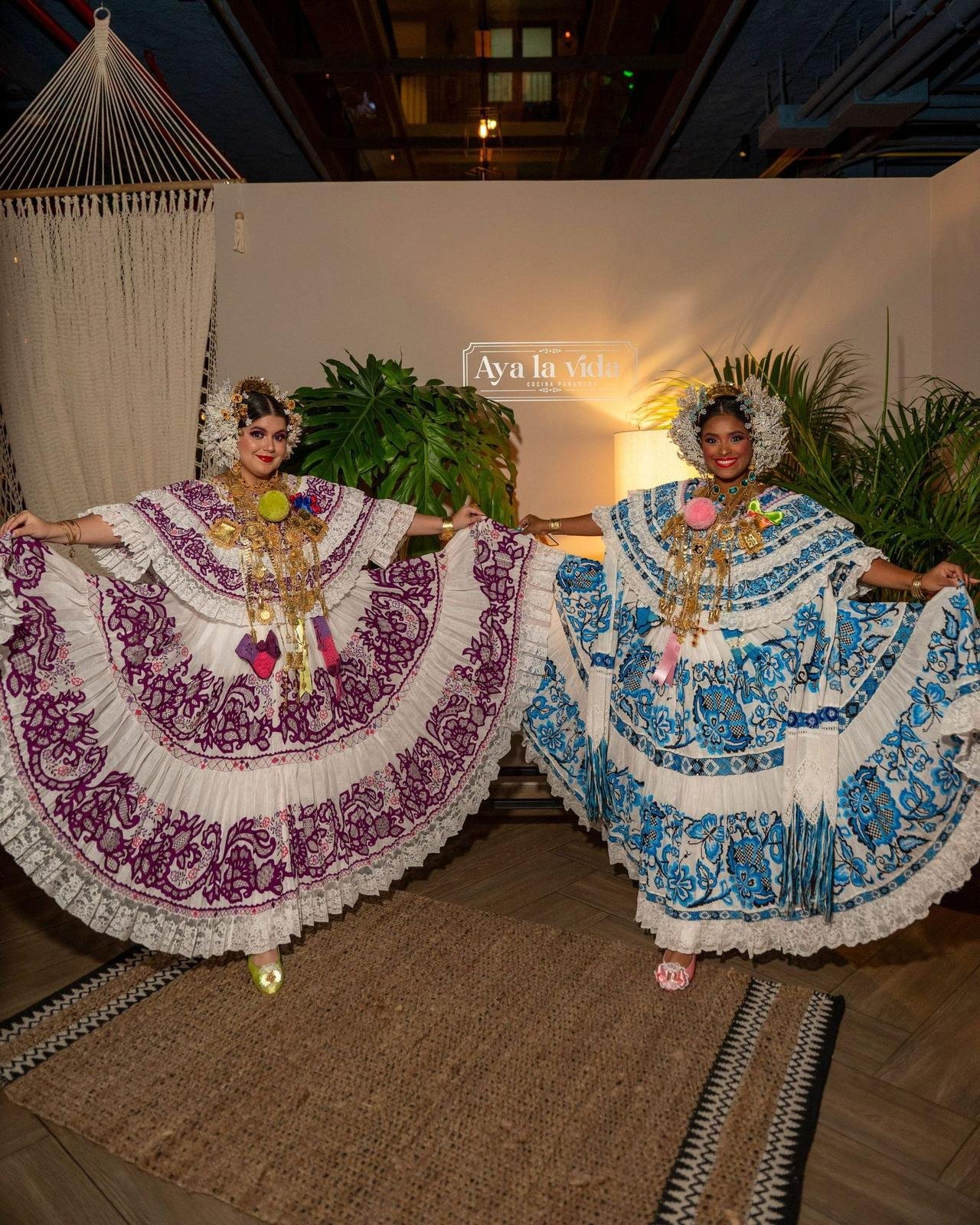
Few garments in the Americas inspire as much pride as the Panamanian pollera, the national dress. It has roots in Spanish colonial clothing, but it evolved on the isthmus into a symbol of its own: a blouse and full skirt of white fabric worked with embroidery, lace, and handmade needlework that can take months — sometimes more than a year — of artisanal labor.
The ensemble is completed with tembleques, headpieces crafted from pearls and scales that tremble with every movement, and gold jewelry such as chains, combs, and buttons. Many of those pieces are passed down from generation to generation, which is why a pollera is often a family heirloom as well. There are variants by region and occasion, from the gala pollera to simpler everyday or working versions. Men, for their part, usually wear the montuno shirt and the sombrero pintao, Panama's traditional woven hat.
Watching it in motion during a dance is all it takes to understand why Panamanians celebrate it as living heritage: it is not a costume, it is identity.
When and Where to See Folklore in Panama
The folklore calendar is concentrated in the country's interior. These are some of the best-known events; check each edition's programme and dates before you travel:
- January — Thousand Polleras Parade, Las Tablas (Los Santos): hundreds of women parade through town wearing the pollera.
- Carnival (February or March): Las Tablas hosts one of the most famous carnivals in the country, and on the Caribbean coast it is the high season of the Congos.
- Corpus Christi (movable date): La Villa de Los Santos celebrates with traditional dances of the diablicos and other characters.
- July 22 — National Pollera Festival, Las Tablas: held during the patron saint festivities of Santa Librada.
- August — Festival del Manito, Ocú (Herrera): one of the most traditional rural celebrations.
- September — National Mejorana Festival, Guararé (Los Santos): the main gathering for singers, mejorana players, and dancers.
- November — national holidays: parades across the country, with marching bands, polleras, and plenty of national pride.
Where to Hear It in Casco Viejo
Not every traveler has time to make it out to Azuero, but Panama City also beats with this heritage, reinterpreted by contemporary musicians. In Casco Viejo, Aya la Vida pairs Panamanian cuisine made with 100% national ingredients, under the motto "De la Tierra a tu Mesa" (From the Land to Your Table), with live music from bands like Afropiano and Son Tropical, with an Afro-Caribbean and tropical sound. It is an easy way to go from reading about it to experiencing it.
If you want to plan that night, our practical guide to dinner at Aya la Vida covers opening hours, dishes, how to book, and tips for your visit. You can also see the restaurant's details on the Aya la Vida page.